Your company just won a project in Antwerp. Six engineers arrive in five weeks, two more follow a month later, and one of them is bringing his family. Finance wants predictable costs. The engineers want to know where they will sleep. And you are the person in the middle.
We have handled this exact situation hundreds of times over the past 20 years at Globexs, and this guide covers everything we tell HR and mobility managers in the first call: what corporate housing in Antwerp actually costs, where to place people depending on their work location, what the process looks like, and the mistakes that cost companies money.
Antwerp is not a typical expat destination like Amsterdam or Barcelona. People come here for specific industries:
The port. The Port of Antwerp-Bruges is the second largest in Europe after Rotterdam and handles well over 270 million tonnes of freight a year. Around it sits Europe's largest petrochemical cluster, with BASF, Covestro, ExxonMobil, Total and dozens of contractors running maintenance shutdowns, expansions and long-term projects. These projects need rotating teams of engineers, planners and safety specialists, usually for 2 to 9 months at a time.
The diamond trade. More than 80% of the world's rough diamonds pass through a few streets next to Central Station. Companies in the district regularly bring in traders, graders and family members from India, Israel, Dubai and beyond.
Logistics, fashion and consulting. Antwerp has a dense cluster of logistics headquarters, plus a fashion and creative sector that pulls in international staff on project contracts.
Each of these groups needs housing near a different part of the city, which is where most relocation plans go wrong.
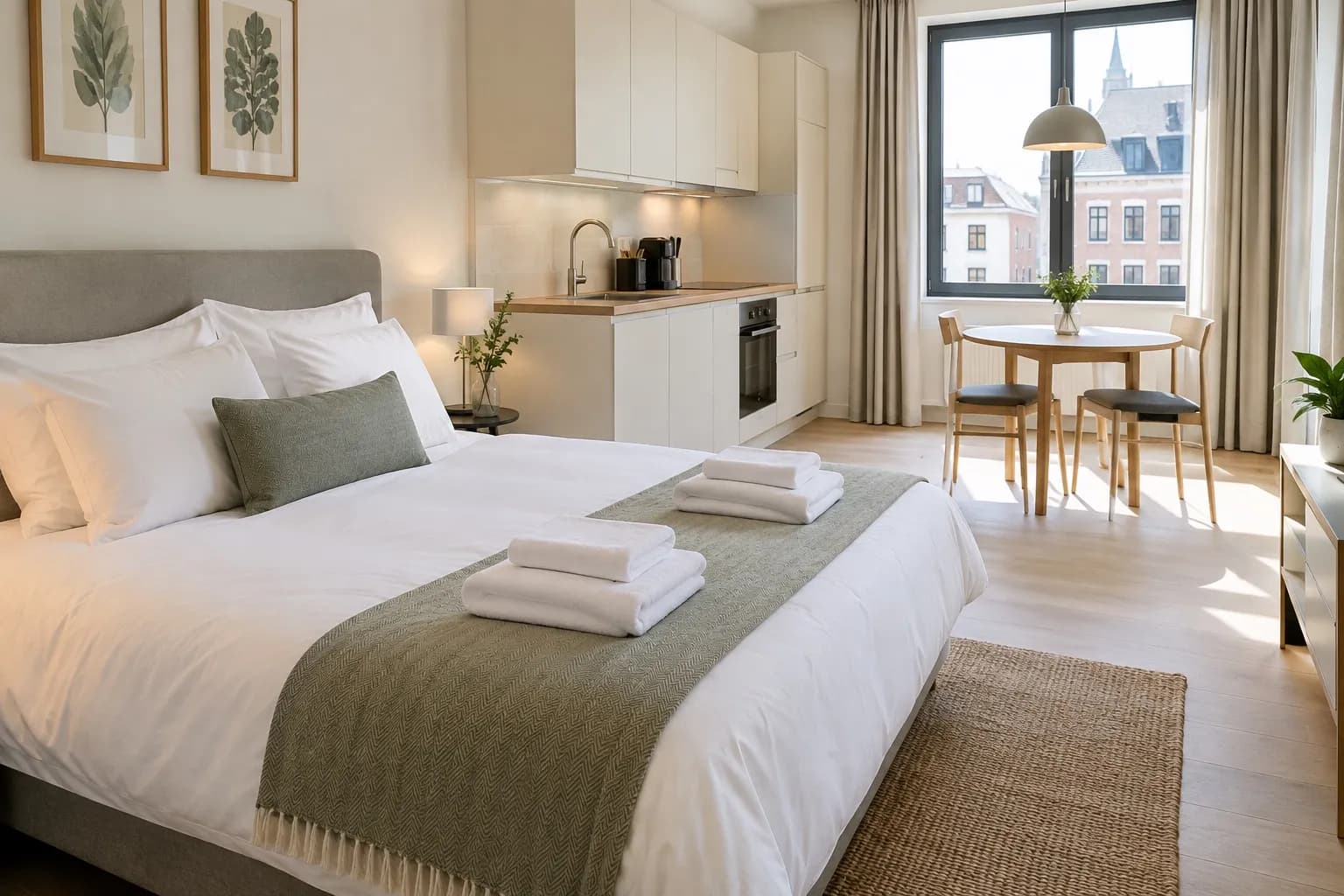
In Belgium, "corporate housing" usually means a fully furnished apartment rented for 1 to 11 months, with utilities and internet arranged, ready on the day your employee lands. No furniture shopping, no Belgian utility contracts in the employee's name, no 3-year standard lease.
That last point matters. The default residential lease in Belgium is long-term and heavily regulated. Breaking it early costs months of rent. A proper mid-term contract is built for project timelines: it ends when the project ends, and it can often be extended if the project runs over. It usually does.
What corporate housing is not: a hotel. A hotel works for two weeks. At month two, your employee is eating takeaway on a bed, morale is dropping, and you are paying €120 to €180 per night for the privilege. A furnished apartment from €1,300 per month works out to a fraction of that, with a kitchen, a washing machine and a door that feels like home.
Realistic monthly budgets for furnished mid-term apartments in Antwerp:
Studio or 1-bedroom, good residential area: from €1,300
2-bedroom, suitable for colleagues sharing or a small family: from €1,600
Premium 2 to 3-bedroom in Eilandje or Het Zuid: from €2,000
Rent out your apartment with Globexs

Utilities and internet are sometimes included, sometimes billed on top at roughly €150 to €250 per month depending on season. Antwerp winters are mild but heating from November to March is a real line item. Always check what "all-in" means before comparing offers. At Globexs the price is all-in, with energy included and no euro cap.
For context, a decent business hotel over the same month costs €3,500 to €5,000. The math is not subtle.
This is the question we spend the most time on, because a bad commute ruins a relocation faster than anything else.
Nobody lives inside the port. Your options are the northern districts (Merksem, Ekeren) and the northern edge of the city centre (Eilandje), or Linkeroever and Zwijndrecht if the site is on the left bank. Most employees at port sites drive, and several large employers run shuttles. Count on 20 to 40 minutes door to door depending on the terminal. Public transport to the port exists but does not match shift hours well, so if your employee will not have a car, tell us early. It changes the answer.
The district sits directly next to Central Station, so anything within walking or short tram distance works: the Stadspark area, the theatre district, or Zurenborg one tram stop away. Many diamond sector employees also have specific food requirements (kosher, strict vegetarian), and this part of town is one of the few places in Belgium where both are easy. We wrote a separate guide on diamond district housing.
Easy mode. Het Zuid, the historic centre, Zurenborg and Berchem itself all work. Berchem station is also the best base for anyone commuting to Brussels a few days a week, with direct trains taking about 40 minutes.
Here is how a team relocation runs when it runs well:
Needs list. You send us the headcount, arrival dates, budget per person, work locations and any specifics (families, pets, parking, ground floor). Half a page is enough.
Proposal. You get a shortlist of real, available apartments with photos, prices and locations. Not stock photos of "similar units".
One all-in invoice. Rent and energy arrive together on one monthly invoice, issued on a fixed date, and your finance department deals with one counterparty, in English.
Staggered arrivals. Each employee gets their own start and end date. When the project extends, the contracts extend. When someone leaves early, we talk about it like adults.
Arrival. Keys, internet working, bed made. The employee lands and starts work the next day.
The whole cycle from first email to first check-in can be as short as two weeks, though four to six weeks gives better choice, especially between August and October when demand peaks.
Booking hotels "for now". "For now" becomes three months, and the budget is gone.
Letting each employee find their own place. You end up with eight landlords, eight contracts in Dutch, eight deposits, and eight sets of problems, all of which land on your desk anyway.
Ignoring commute direction. An apartment in the lovely south of the city and a job at the northern port terminals means 45 minutes each way through the Kennedy tunnel traffic. People quit over this.
Signing standard Belgian leases. See above. The exit costs are painful.
Starting the search two weeks before arrival in September. September is the tightest month of the year. Everything good is gone.
Employees staying longer than 90 days generally need to register with the local commune, and non-EU staff need the right permits before they arrive. Requirements vary by nationality and contract type, so we will not summarize them in two sentences here. Check them with your immigration adviser early. Globexs apartments can be used as a registered address when the owner agrees, and the signed lease is the proof of address the commune asks for. Useful official starting points: the City of Antwerp's international newcomers desk (antwerpen.be), the federal immigration office (dofi.ibz.be), and for port-related planning, portofantwerpbruges.com.
For a Q4 project start, begin the housing search in July or August. For January starts, October is comfortable. If you are reading this with a team landing in three weeks, it is not too late, but call rather than email.
If you are relocating a team to Antwerp and need furnished apartments with flexible dates and one all-in monthly invoice, this is exactly what we do at Globexs. Send us your headcount and dates, and you will have a shortlist of real apartments this week.