Property Owners
Discover the Benefits of Expat Rentals
Rent out your apartment with Globexs

Rent out your apartment with Globexs

Somewhere right now, a person who just accepted a job in Brussels is typing this exact question into a search box or an AI chat, and getting answers that range from "Brussels is cheap for a capital" to "you cannot survive under €3,000". Both answers are half true, which makes both useless.
So here is the honest version, with real 2026 numbers. We have housed expats, EU staff and corporate transferees in Brussels for over 20 years at Globexs, which means we watch actual budgets meet actual life every month. The short answer first, then the math behind it.
A single person needs a net income of about €2,300 to €2,700 per month to live comfortably in Brussels in 2026: a decent one-bedroom in a good neighbourhood, eating out weekly, transport, insurance, some travel, some savings. Life is workable from about €1,800 with a compromise on housing (a smaller place, a flatshare, or a further neighbourhood). Below €1,500 Brussels becomes genuinely hard unless housing is subsidised or shared.
A couple lives well from about €3,400 to €4,000 net combined, because the biggest cost, rent, barely grows when a second person joins. A family with two children should think from €4,800 to €5,500 once school-adjacent costs and space enter the picture.
Those are the headline numbers. Whether they apply to you depends almost entirely on one line of the budget, so let us start there.
Housing is 35 to 45 percent of a normal Brussels budget, and everything else is rounding by comparison.
On the classic long-term market, an unfurnished one-bedroom runs roughly €900 to €1,250 per month depending on the commune, a two-bedroom €1,200 to €1,700. Add €150 to €250 for utilities (heating is the big one from November to March) and remember that unfurnished in Belgium means genuinely empty.
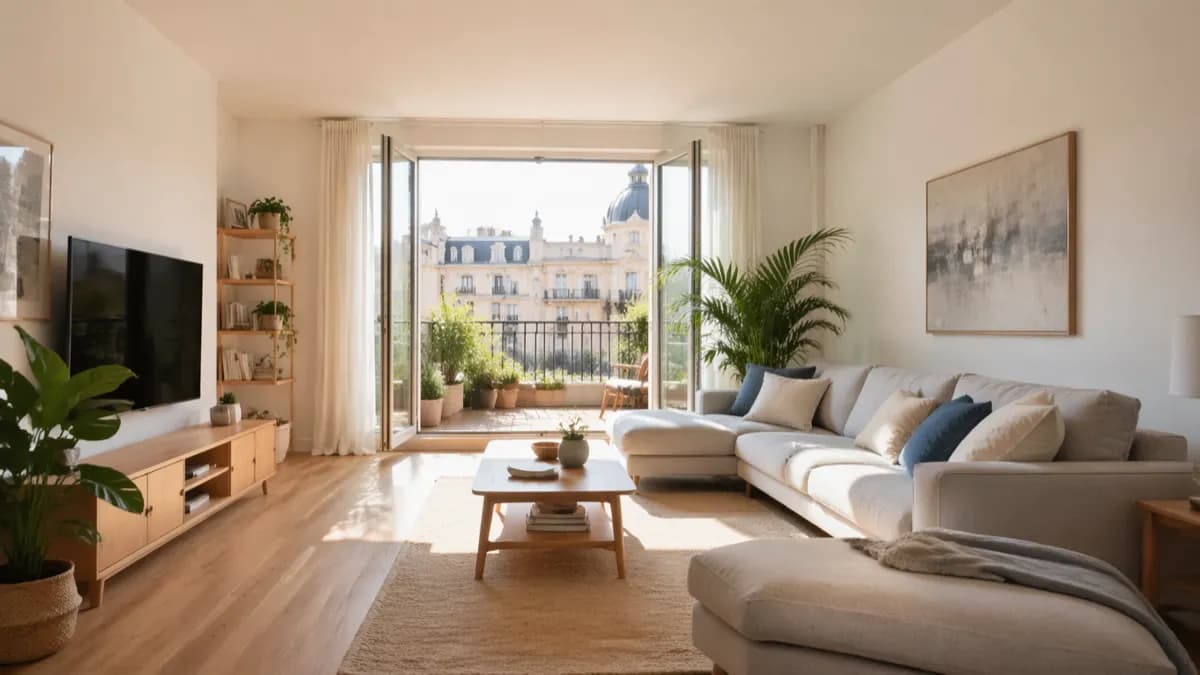
Furnished mid-term apartments, the kind you rent for 1 to 11 months with utilities and internet handled, start from about €1,300 in honest neighbourhoods like Saint-Gilles or Etterbeek and from €1,500 in Ixelles, all-in or close to it. More per month than the bare long-term flat, and usually less than people calculate once furniture, deposits, utility contracts and the empty first weeks are honestly priced. We wrote a separate neighbourhood-by-neighbourhood rent guide with the full map.
The rule of thumb Belgian landlords themselves use: rent should not pass one third of your net income. Brussels landlords ask for payslips and apply it.
Groceries for one, cooking mostly at home: €280 to €350 per month; for a couple €450 to €550. Colruyt is the cheap chain, Delhaize and Carrefour the standard, and the Sunday markets (Midi is the famous one) beat them all on produce.
Eating out: a weekday lunch menu €15 to €20, a proper dinner €25 to €45 per person, a Belgian beer €4 to €5, a coffee €3 to €3.50. Brussels restaurant life is very good and priced like a Western European capital, no more.
Transport: this is where Brussels is quietly generous. A monthly STIB pass costs about €49 and the network (metro, tram, bus) genuinely covers the city. Most expats do not need a car, which deletes a €400 to €700 monthly line that exists in most other lives. If you do drive: parking permits are cheap, parking spaces are not, and traffic is the worst in Belgium.
Healthcare: Belgium runs on the mutualité system, mandatory insurance that costs surprisingly little (basic membership from around €10 per month, hospitalisation cover another €10 to €30) and reimburses most of your medical costs. A GP visit costs around €30 upfront with most of it reimbursed. It is one of Europe's best systems and one of its most confusingly administered; our guide to Belgian healthcare for expats untangles it.
Phone and internet: €60 to €90 for both. Gym: €25 to €50. The famous Belgian line item: taxes are high on paper, but if you are comparing job offers, compare net salaries and remember Belgian gross-to-net is brutal (roughly 45 to 50 percent disappears at professional incomes) while the social package underneath (healthcare, pension, holiday pay, 13th month in many sectors) is thick.
The stagiaire. The EU traineeship grant sits around €1,400 to €1,500 per month. That funds Brussels only with shared or budget housing: a flatshare room (€550 to €750) or a studio at the compromise end. Doable, done by thousands twice a year, and tight. There is a reason the stagiaire housing scramble is a Brussels institution.
The single professional at €2,600 net. One-bedroom in Saint-Gilles or Etterbeek, STIB pass, weekly restaurants, a Ryanair weekend a month, €200 to €400 saved. This is the comfortable default Brussels life and most EU and corporate salaries at professional grades clear it.
The couple at €4,200 combined. Two-bedroom in Ixelles near Flagey, real restaurant life, a car or a lot of trains, solid savings. Brussels at this level is a genuinely lovely, slightly underrated European life.
The corporate transferee on a 6-month project. Different math entirely: the company pays, and the comparison is not rent vs salary but furnished apartment vs hotel, where the apartment from €1,400 beats €4,000+ of hotel nights every month. That calculation has its own article on our corporate side.
Down: sharing housing (the single biggest lever), the outer communes (Jette, Schaerbeek's quieter parts, Anderlecht's better corners knock €200 to €300 off rent), no car, Colruyt discipline. Up: international school fees if the employer does not carry them (this alone reorders a family budget), a car in the centre, the EU-bubble social calendar, and the first months, which always cost more than steady state because deposits, setup and not yet knowing where anything is cheap are a tax on newness.
Brussels in 2026 is cheaper than Paris, London and Amsterdam by a clear margin, more expensive than Valencia or Lisbon, and unusual in how much of the cost concentrates in one decision: where you live. Get the housing right for your income and the rest of the city is manageable; get it wrong and no amount of Colruyt fixes it.
Which is why our standing advice at Globexs, after 20 years of watching budgets meet Brussels, is to not sign anything long before living here briefly. A furnished apartment for 1 to 11 months, from €1,300 per month, lets you test your real budget in your candidate neighbourhood before the long-term commitment, with everything connected from day one. Come run your own numbers; the city will tell you which profile you are within a month.