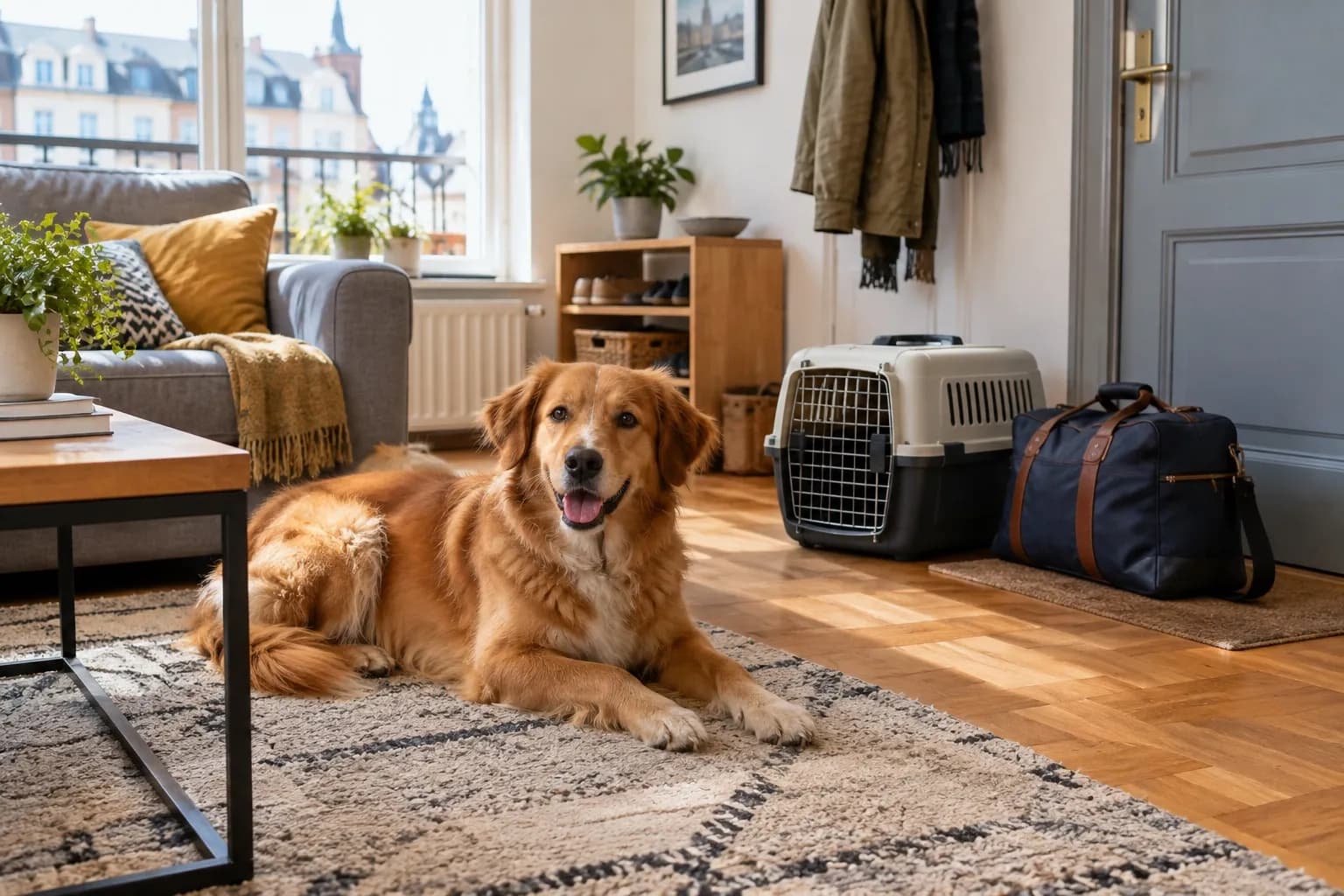
For many people, the dog or the cat is not negotiable: if they move, the animal moves too. Moving to Belgium with a pet is straightforward on the travel side, as long as you start early, and harder on the housing side, because many landlords hesitate. This guide covers the EU travel rules for dogs and cats, the extra steps if you come from outside the EU, the registration Belgium requires after arrival, and how to rent a furnished apartment with an animal.
Dogs and cats travelling to Belgium need a microchip, a valid rabies vaccination and the right document: an EU pet passport within the EU, or an EU animal health certificate from outside it. Coming from some non-EU countries also requires a rabies blood test months before travel. If the animal stays in Belgium longer than six months, a Belgian vet registers it in the national database shortly after arrival.
For housing, tell the landlord about the animal before you sign anything. In a furnished apartment, the owner's agreement is what decides.
Within the EU, a dog, cat or ferret travelling with its owner needs three things.
A microchip, implanted before the rabies vaccination. A readable tattoo applied before 3 July 2011 is also accepted.
A rabies vaccination given when the animal was at least 12 weeks old. After the first vaccination, wait at least 21 days before travelling. Boosters must be given before the previous one expires.
A valid EU pet passport issued by a vet, recording the microchip and the vaccination.
You can travel with up to five animals under these rules. Belgium does not require the tapeworm treatment that Finland, Ireland, Malta and Norway ask for.
The EU updated its legal framework for travelling with pets in April 2026. The official Your Europe guidance lists the requirements above; check it and talk to your vet a few weeks before you travel.
From outside the EU, the same microchip and rabies vaccination apply, plus extra paperwork and, for many countries, a blood test.
Requirement | Within the EU | From outside the EU |
|---|---|---|
Microchip | Yes | Yes |
Rabies vaccination | Yes, from 12 weeks of age, 21 days before travel | Yes, same rules |
Travel document | EU pet passport | EU animal health certificate from an official vet, issued no more than 10 days before arrival |
Rabies antibody blood test | No | Yes, unless the country is on the EU's exempt list |
Waiting period after the blood test | Not applicable | 3 months from the date of the blood sample |
Written declaration | No | Yes, confirming the move is not commercial |
Where you enter | Anywhere | A designated travellers' point of entry |
The blood test is what makes early planning essential. The sample is taken at least 30 days after vaccination, must show at least 0.5 IU/ml, and must be analysed by an EU-approved laboratory. Then you wait three months before the animal can enter. In practice, start four months before your moving date at the latest.
Rent out your apartment with Globexs

At the border, the Belgian food safety agency (FASFC) checks the microchip and documents. If something is missing, the animal can be refused entry, placed in quarantine or sent back, at the owner's cost.
Every dog and cat that lives in Belgium must be identified and registered in the national databases: DogID for dogs, CatID for cats. Only a vet can register an animal.
If your animal already has a microchip and will stay in Belgium longer than six months, a Belgian vet registers it within eight days of arrival. Animals accompanying their owner for a shorter stay are exempt. Book the vet appointment in your first week; you will want a local vet anyway.
Some rules are regional. Cat sterilisation rules, for example, differ between Flanders, Brussels and Wallonia, so ask your vet what applies at your address. Communes also set local rules on leashes and dog areas in parks.
Many Belgian landlords are cautious about pets, and in a furnished apartment the caution is higher. The owner is renting out their own furniture, floors and curtains, often in a building with neighbours close by.
The law differs by region. In Brussels, since 1 November 2024, a lease clause that bans pets outright is invalid under the Brussels Housing Code; the lease can still set reasonable conditions, such as no nuisance and limits on the number or type of animals. In Flanders, a lease can restrict or exclude pets. In every region, the building's own house rules can add conditions for common areas.
What owners usually want to know:
species, breed, size and age
whether the animal is house-trained and used to being alone
vaccination records and the microchip number
whether it barks, scratches or sheds heavily
whether your liability insurance covers damage caused by the animal
A short "pet CV" with these points, a photo and a reference from a previous landlord answers most questions before they are asked.
Choose the ground floor or a building with a lift if you have a large dog.
Look for a park within walking distance. Brussels, Antwerp and Ghent all have green areas, but they are not evenly spread.
Keep the vaccination records and passport in your hand luggage, not in the moving container.
Bring the animal's own bed and bowl. A familiar smell helps it settle in a new apartment.
Ask the owner before you add a crate, a scratching post or anything fixed to the walls.
Globexs has rented furnished apartments to expats since 2002. In Belgium we rent apartments in Brussels, Antwerp and Ghent on contracts from one to eleven months.
Pets are possible with the owner's approval. Every case is decided separately, depending on the animal, so tell us about it before you book: species, breed, size and age. That way the owner's answer is known before anything is signed.
All-in price that includes energy, with no cap in euros.
Antwerp from EUR 1,300 a month, Ghent from EUR 1,500 a month.
Extension by one email.
From private tenants we need an ID only; no Belgian bank account.
Corporate housing across Belgium · Brussels · Antwerp · Ghent · How renting with Globexs works
A microchip, a rabies vaccination given at 12 weeks or older at least 21 days before travel, and an EU pet passport. Belgium does not require a tapeworm treatment.
You need an EU animal health certificate issued by an official vet no more than 10 days before arrival, and for many countries a rabies blood test taken at least three months before travel. Enter through a designated travellers' point of entry.
Yes, if the animal stays longer than six months. A Belgian vet registers it in DogID or CatID within eight days of arrival.
It depends on the region. In Brussels, a clause banning pets outright is invalid since November 2024, although reasonable conditions are allowed. In Flanders, a lease can restrict or exclude pets.
Yes, with the owner's approval. Each case is decided separately depending on the animal, so tell us about your pet before you book.
Ask first. The owner's approval applies to the specific animal, so the request has to be made before the animal arrives.
Within the EU, a few weeks is usually enough if the vaccination is valid. From a country that requires the blood test, start at least four months ahead.